Kutter Callaway is my guest for a discussion of his new book Be Afraid: What Horror Reveals About Facing the Darkness (IVP, 2026). From the publisher’s description: “In Be Afraid, theologian and psychological scientist Kutter Callaway explores the surprising relationship between fear, horror, and Christian faith. Drawing from film, psychology, and theology, this book engages popular horror narratives to ask what our deepest fears reveal about what we truly love, long for, and believe.” https://www.ivpress.com/be-afraid?srsltid=AU7gw4V8L-OdgI2xki4Rb96Tfj8QjIBPXwd_xyzt7SIR_77-PZj47G0d
Kutter Callaway (PhD, Fuller) is the William K. Brehm Chair of Worship, Theology, and the Arts, associate professor of theology and culture, and associate professor of psychology at Fuller Theological Seminary. He writes and speaks on the interaction between theology and culture—particularly film, television, and online media—in both academic and popular forums. Callaway holds two PhDs, one in theology and the second in psychological science. He is the host of the Be Afraid podcast,and is author of Deep Focus, The Aesthetics of Atheism, Watching TV Religiously, and Scoring Transcendence. He lives with his wife and three daughters in LA. https://www.kuttercallaway.com/
From Close Encounters to Disclosure: Spielberg’s Alien Imaginary and American Spirituality
Proposed Edited Volume for the Pop Culture and Theology Series
Since the release of Close Encounters of the Third Kind in 1977, Steven Spielberg has played a significant role in shaping popular cultural understandings of extraterrestrial intelligence, UFOs, and humanity’s relationship to the unknown. Across films such as Close Encounters of the Third Kind, E.T. the Extra-Terrestrial, War of the Worlds, and Indiana Jones and the Kingdom of the Crystal Skull, Spielberg has repeatedly returned to themes of cosmic encounter, wonder, fear, revelation, otherness, and transcendence. His forthcoming film Disclosure Day appears poised to revisit these themes in a dramatically different cultural context—one increasingly shaped by public discussions of UAPs (Unidentified Anomalous Phenomena), government disclosure initiatives, conspiracy cultures, and renewed fascination with extraterrestrial possibilities.
This volume proposes that Spielberg’s alien-centered films constitute more than entertainment. Taken together, they provide a unique lens through which to examine changing American hopes, fears, spiritual longings, mythologies, and religious imaginations from the late twentieth century to the present.
Contributors are invited to explore Spielberg’s evolving treatment of UFOs, aliens, and cosmic encounter as expressions of broader cultural and religious concerns. The volume welcomes interdisciplinary approaches from theology, religious studies, film studies, media studies, cultural studies, sociology, psychology, folklore, mythology, philosophy, and related fields.
Particular attention will be given to the ways Spielberg’s films function as sites where questions of transcendence, revelation, meaning, apocalypse, identity, and humanity’s place in the cosmos are negotiated within popular culture.
By examining Spielberg’s alien imaginary across nearly five decades of filmmaking, this volume seeks to illuminate how extraterrestrial narratives have functioned as a cultural arena for negotiating humanity’s deepest questions about transcendence, fear, hope, identity, revelation, and the sacred unknown.
Suggested Thematic Sections
Section I: Spielberg and the Sacred Unknown
This section explores Spielberg’s portrayal of extraterrestrial encounter as a source of wonder, transcendence, mystery, and spiritual transformation.
Possible topics include:
Close Encounters of the Third Kind as a modern pilgrimage narrative
UFO contact as revelation and religious experience
Sacred space and liminality in Spielberg’s alien films
Spielberg’s cinematic treatment of awe and wonder
The relationship between science, mystery, and transcendence
Cosmic encounter and the search for meaning
Religious themes in Spielberg’s treatment of first contact
Alien encounter as conversion, calling, or vocation
Section II: Aliens as Mirrors of Humanity
This section considers how Spielberg’s extraterrestrials reflect human concerns about identity, morality, belonging, and community.
Possible topics include:
Hospitality, empathy, and moral imagination in E.T.
Aliens as outsiders, strangers, and cultural others
The ethics of encounter with radical difference
Family, belonging, and vulnerability in Spielberg’s alien narratives
Theological readings of friendship across difference
Human identity constructed through extraterrestrial encounter
Childhood, innocence, and spiritual imagination
Alien figures as mirrors of human longing and alienation
Section III: Fear, Apocalypse, and Threat
This section examines the darker dimensions of extraterrestrial encounter and the cultural anxieties expressed through invasion narratives.
Possible topics include:
War of the Worlds and post-9/11 American fears
Alien invasion as apocalyptic imagination
Catastrophe, vulnerability, and existential threat
Trauma and survival in Spielberg’s alien films
Theodicy and cosmic indifference
Fear of the Other in science fiction cinema
Technology, power, and vulnerability
Extraterrestrials as embodiments of collective anxiety
Section IV: UFOs, Myth, and Modernity
This section situates Spielberg’s work within broader discussions of mythology, symbolism, and modern spirituality.
Possible topics include:
Carl Jung’s interpretation of UFOs as modern myths
UFOs as symbols of collective hopes and fears
Mythological dimensions of Spielberg’s alien narratives
UFOs and the evolution of American civil religion
Extraterrestrials and contemporary spiritual seeking
Spielberg and the mythology of cosmic salvation
UFO religions and popular spirituality
Folklore, myth-making, and extraterrestrial narratives
The sacred and the secular in modern UFO culture
Section V: Disclosure, Post-Secular Culture, and the Future
This section addresses contemporary developments in UFO/UAP discourse and their relationship to Spielberg’s cinematic imagination.
Possible topics include:
Government disclosure narratives and popular culture
Spielberg’s forthcoming Disclosure Day and contemporary UAP debates
The emergence of post-secular UFO discourse
Social media, conspiracy cultures, and extraterrestrial belief
Public fascination with disclosure movements
Extraterrestrials and the future of religious imagination
Artificial intelligence, non-human intelligence, and the evolving unknown
The future of alien narratives in American culture
Additional Topics Welcome
The editors also welcome proposals on:
Spielberg’s personal engagement with UFO and extraterrestrial themes
Comparative studies involving Spielberg and other directors
UFOs and race, gender, or identity
Political theology and extraterrestrial narratives
Environmental themes and cosmic encounter
The role of music, sound, and visual spectacle in creating transcendence
Alien encounter and theories of religious experience
The intersection of UFO culture and contemporary spirituality
Submission Guidelines
Please submit:
A 300–500 word abstract
A brief biographical statement (100–150 words)
Full chapters will typically range between 5,000–7,500 words.
The editor particularly encourages contributions that engage both popular culture and theological, religious, mythological, or philosophical analysis.
Barrett and Jessica Burgin are filmmakers with their company Burgindie Pictures. One of their recent projects is the short film The Angel, a film that combines aspects of Mormon religion, folklore and history with horror. We unpack their story and the film in this conversation.
Jessica has produced for internationally recognized film and media brands including HBO, 5&2 Studios, BYUtv, and Excel Entertainment, and recently worked as production coordinator on the documentary Artifact War (2024), which premiered at the Austin Film Festival. The Angel marks her directorial debut.
Barrett is an award-winning writer, director, producer, and published media scholar whose research examines religious identity and modes of storytelling, and whose student feature film CRYO (2022) was acquired by a national distributor and released theatrically. His work is studied in collegiate courses.
Their collaborative work—including the acclaimed shorts The Angel (2024) and Java Jive (2025)—are recognized for their engagement with Latter-day Saint theology, folk belief, and the simultaneous celebration and critique of Mormon thought and culture.
About The Angel A Mormon Pioneer folk horror. Two plural wives receive a mysterious visitation amidst the blood red stone of Southern Utah. Our film mines the mystic folk doctrines of these settlers to portray a demonology never before depicted on screen. We are uniquely qualified to tell this story, as both of our directors claim that cultural heritage. The Angel serves as a proof of concept for an award winning feature screenplay, The Third Wife, which has received industry interest for its commercial viability and been spotlighted by the Sundance Institute. The short has also been included in the Short Film Corner at Cannes, played at numerous prestigious film festivals, and even garnered academic attention for its historicity from a range of institutions, including BYU-Hawaii, Ralston College, the Association for Mormon Letters, the Center for Latter-day Saint Arts, the Mormon History Association, and the Sunstone Institute.
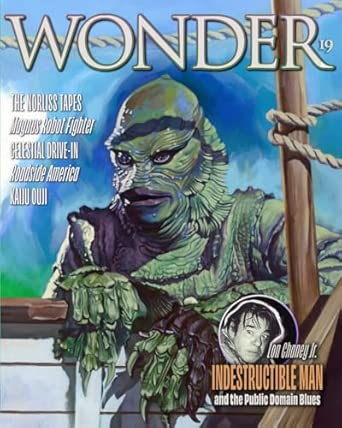
I first met the creators of WONDER magazine, Lint Hatcher and Rod Bennett, at Cornerstone Festival and its Imaginarium venue many years ago. I developed a friendship with Lint as we share a love for all things Geek culture with a connection to the sacred. For the last few years this has included my meager contributions to WONDER MAGAZINE in the form of toy and memorabilia reviews. The current issue is out, number 19 for 2026, and I not only have reviews included, but an interview as well. It’s with Dr. Jeffrey Thompson, a Dan Curtis expert who recently won a Ronda Award, where we discuss one of my favorite Curtis productions, The Norliss Tapes. I encourage every monster kid, especially those with an intuition that monster stuff includes a window into transcendence, to pick up the latest copy of WONDER at Amazon and look at their extensive catalog of back issue treasures as well.
This week I made some cool discoveries in Substack with new authors addressing topics I’ve followed for years. The first has application to the recent success of the Artemis II mission. I watched the rocket blast off into space and kept tabs with its mission over the days that followed, and like millions of other Americans I watched with a slight bit of nervousness as they re-entered Earth’s atmosphere, hoping the heat shield would do its job. The mission brought back memories of the Apollo missions of the late 1960s and 1970s that I watched as a kid. The Artemis mission has reinvigorated the American space program with the plans for a fresh landing on the moon and the establishment of a permanent base, and continued hopes for sending astronauts to Mars. But I must admit that while I find the space program fascinating, and undoubtedly a shining example of America’s technological abilities, I think the hopes for a Mars mission, and perhaps future interstellar travel, are really current expressions of the new frontiers myth rather than real scientific possibilities. I was reminded of this in a Substack piece by Jason Pargin titled “Interstellar Space Travel Will Never, Ever Happen.” In the piece he lists several scientific reasons why this is the case, and I find it compelling. Because of these realities, our space program provides a mythic hope that dovetails the new frontiers myth as expressed in science fiction tails.
This leads me to my second great find on Substack, a series on aliens in science fiction by Graham Lau. This is a multipart series on Mythologies of Alien Life, where looks at the historical development of alien concepts, including how this has been shaped in science fiction. I’ve discussed science fiction as myth previously on this blog, and I am pleased to see Lau take up the topic. You can read Part 4 of his series here where looks at science fiction from the 1900s and how the concept of aliens evolved from this context. I’d encourage reading the other parts of the series as well.
Finally, Lau’s Substack introduced me to a new concept and author, Jason D. Batt’s work on Xenomythology, defined as “The interdisciplinary study of how mythological structures, archetypes, and religious systems might form among non-human intelligences. Xenomythology synthesizes depth psychology, comparative mythology, astrobiology, and evolutionary biology to explore the conditions under which myth-making arises—and challenges the assumption that human mythological patterns are universal.” Although I’ve studied UFOs/UAPs and the theological implications of possible alien life, surprisingly this was my first encounter with Xenomythology. Lau explores this on his wonderful Substack at The Stellar Furnace (including some other great posts on science fiction like Frankenstein). You can read one of his posts on Xenomythology here, and for a deeper dive check out his website Xenomythology.
In the past one of the areas of study and commentary on this blog has looked at identity and popular culture narratives in the form of vampires and Otherkin. I hadn’t come across this recently until I started reflecting on philosopher Charles Taylor’s influential work related to secular modernity. In his book A Secular Age he notes that secularism involves an emphasis on subjective, constructed identities. Many times in modernity our identities are largely evolving subjective constructs with little connection to broader community considerations. Pop culture plays a significant part in the process of identity construction, particularly in the case of those who believe they have an “Other-Than-Human” identity. I recently came across a couple of journal papers on this, one by Clive Baldwin and Lauren Reply from QSR, and the other by Devin Proctor in Engaging Science, Technology, and Society. Proctor’s paper focuses on Otherkin, while Baldwin and Ripley’s looks at Otherkin, Therianthropes, and Vampires. The latter article defines these groups as follows: “Otherkin are those who identify, in whole or in part, as other-than-human.” This includes “dragonskin, angelkin, elvenkin, unicornkin, and so on.” Therians are those “who identify, in whole or in part, as other-than-human, but as Earth animals such as wolves, dogs, cats, cheetahs, and so on.” Vampire identity is understood as those who need human blood or energy for sustenance.
One of the more interesting aspects of the Baldwin and Ripley study on these groups and the importance of narrative in identity construction comes by way of this paragraph:
“Otherkin and Therians do not consciously create the identity, rather it is something present at birth, eventually realized as they ‘awaken’ to their true identities. In this way, some participants compare it to transgender identity, where one feels and identifies with the gender opposite to that which they were designated at birth.”
Various “other-than-human” groups make for a fascinating study in subjective narrative construction often resourced by aspects of popular culture such as fantasy or horror narratives. To read the Baldwin and Ripley study click here. For Proctor visit this link.
Those familiar with the discipline of monster studies are aware of the seminal work of Jeffrey Cohen and his influential book Monster Theory: Reading Culture. This book is now thirty years old! Cohen recently made an announcement on Facebook that he has edited a forthcoming volume titled Monster Theory at Thirty published by the University of Minnesota Press. The volume is due out early next Spring. In his Facebook post Cohen included an image from the table of contents with the titles from the volume’s twenty-seven contributors. As someone involved in the academic study of monsters for some twenty years, it is great to see this thesis have continued life and fresh explorations by young and older scholars alike.
Someone in my social media feed announced their contribution to this new volume. It looks great. Routledge Handbook of Dark Events: Celebrations, Heritage, and Customs of Death and the Macabre. From the Routledge website:
This handbook explores and critically evaluates key debates and controversies in the emerging field of Dark Events. It brings together leading specialists from a range of disciplinary backgrounds and geographical regions to provide state-of-the-art theoretical reflection and empirical research on celebrations, heritage and customs of death (events) and the macabre.
Divided into ten parts, the book explores traditions of dark festivals and events; the display of the dead; commemoration and authenticity within the context of dark events; dark events from the past; dark events in popular culture; controversial dark events; grief and memory; managing dark event experiences; decolonisation and equality for the dead; and dark event futures. This significant volume offers the reader a comprehensive synthesis of this emerging field, conveying the latest thinking and research. The text is international in focus, encouraging dialogue across disciplinary boundaries and areas of study, providing an invaluable resource for all those with an interest in Dark Events.
This is essential reading for students, researchers and academics of Dark Events, as well as those of related studies such as tourism, cultural studies, leisure, geography, sociology, death studies and museums.